

The 4th international summer school “Learning from the past – Bosnia and Herzegovina 1995 – 2017: Lessons Not Learned” provided an opportunity to undergraduate students and graduate students as well as to emerging researchers and professionals to meet and study with people from different countries, cultures and academic disciplines, on a cosmopolitan campus in Sarajevo and in real post-conflict communities. Sadly, Bosnia-Herzegovina, and the Balkan region, in many regards remain in a post-war state, where there is great need for healing from the past trauma, while the tensions that led to the 1990s war are largely undealt with, still affecting everyday life of majority of citizen of BiH.
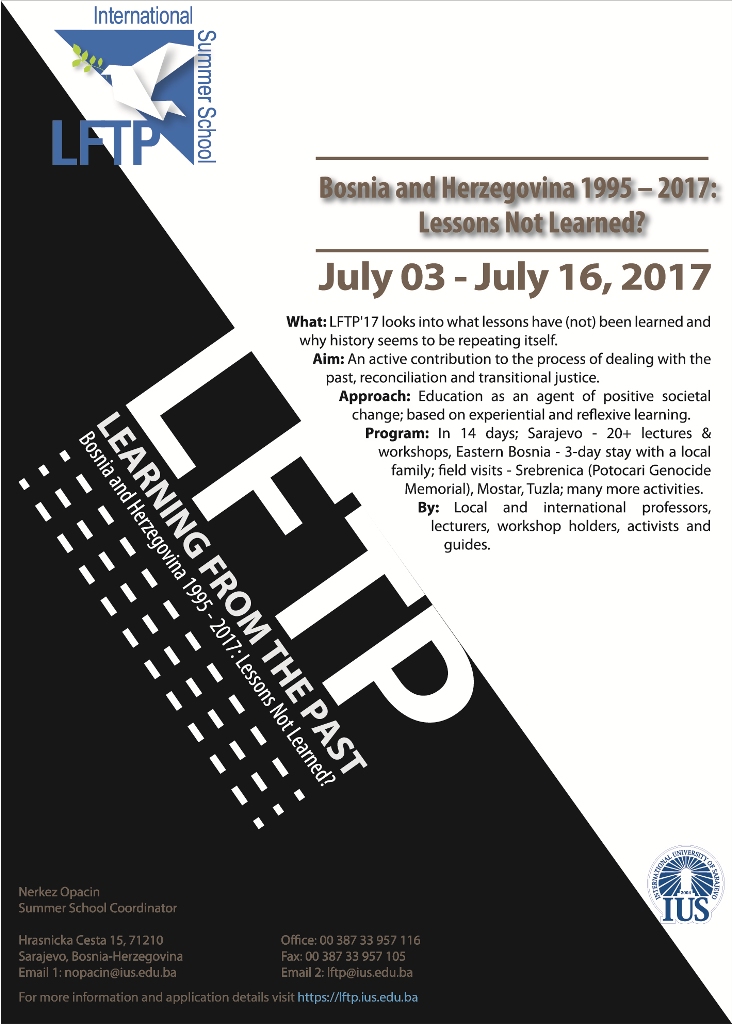
Although there are many GOs and NGOs in and around BiH working towards advancing transitional justice and reconciliation, they hardly show any tangible or real-world outcomes. BiH and the Balkans are the largest living laboratory for this area of study. By learning about the past and current issues in BiH, this summer school also commemorated the events by remembering and discussing the past atrocities, and at the same time sought to help students learn how we might move beyond the tragic events in the past in order to achieve lasting peace in the region. For this to be achieved, a range of teaching and learning approaches and strategies were utilized - delivered in a form of lectures, class discussions, workshops, field visits and conferences - and focusing on comparative studies enabling the participants to learn in an experiential and cross-cultural context.
Furthermore, this summer school provided an opportunity to filter previously generated knowledge in regard to conflict resolution and further advanced methodological tools and techniques applicable to research in the field of genocide, transitional justice, post-conflict resolution, peace-building, security studies, conflict-prevention diplomacy, international law, sociology, anthropology and other associated fields. It also promoted the active involvement of participants in order to better understand each other's ethnic backgrounds and the challenge of existing stereotypes and myths about the ‘Other.'
The summer school will applied an integrative interdisciplinary perspective drawing upon a variety of disciplinary approaches inherent to existent methodological frameworks of social sciences. Its overall aim was to capitalize from the previous academic and professional work and research relating to dealing with the past, transitional justice and reconciliation in post-conflict societies.